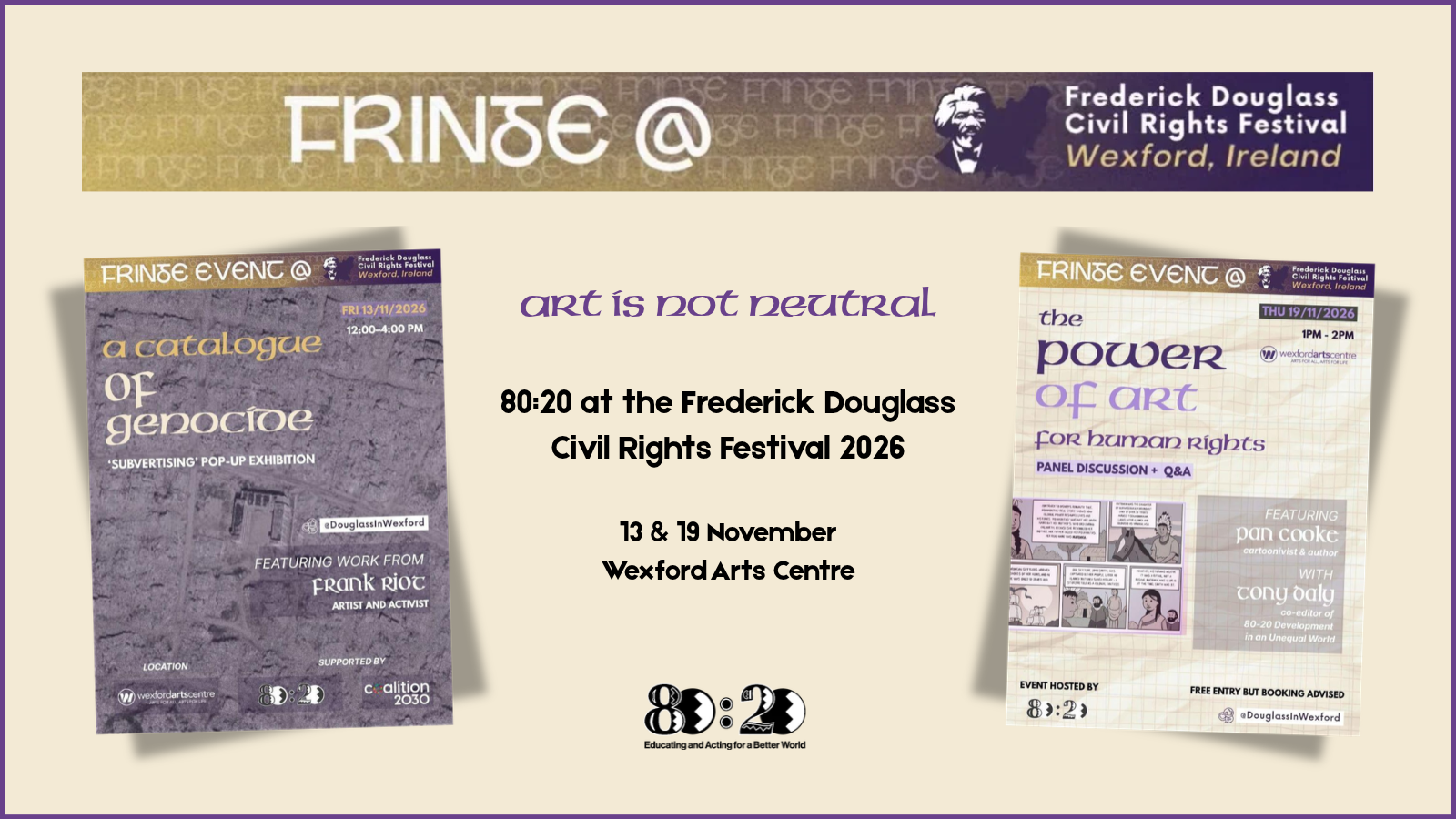
This year, 80:20 Educating and Acting for a Better World is taking part in the Frederick Douglass Civil Rights Festival through two very different, but closely connected, events exploring art, human rights, political storytelling and resistance.
At a time when human rights are being systematically undermined across the world, and when cultural spaces are increasingly shaped by commercial and political interests, the festival creates room for a different kind of encounter. Through exhibitions, discussions, books, music and collective reflection, it asks us to consider what art is for, whose stories it carries and how it can help us recognize and resist injustice.
The Frederick Douglass Festival began in Wexford in 2014 and takes its inspiration from Douglass’s historic visit to the town in 1845. During that visit, the formerly enslaved abolitionist, writer and orator spoke twice in the Assembly Rooms, the building that is now Wexford Arts Centre, asserting his own humanity and that of millions of people held in slavery.
More than 180 years later, his challenge remains urgent.
How do we confront systems that deny people their rights and dignity?
How do we build solidarity across borders without losing sight of unequal relationships of power?
And how can education, culture and public action help change not only individual attitudes, but the structures that reproduce injustice?
For us at 80:20, it is both a pleasure and a source of pride to contribute to a festival that brings historical memory into conversation with contemporary struggles for rights, equality and justice.
A Catalogue of Genocide
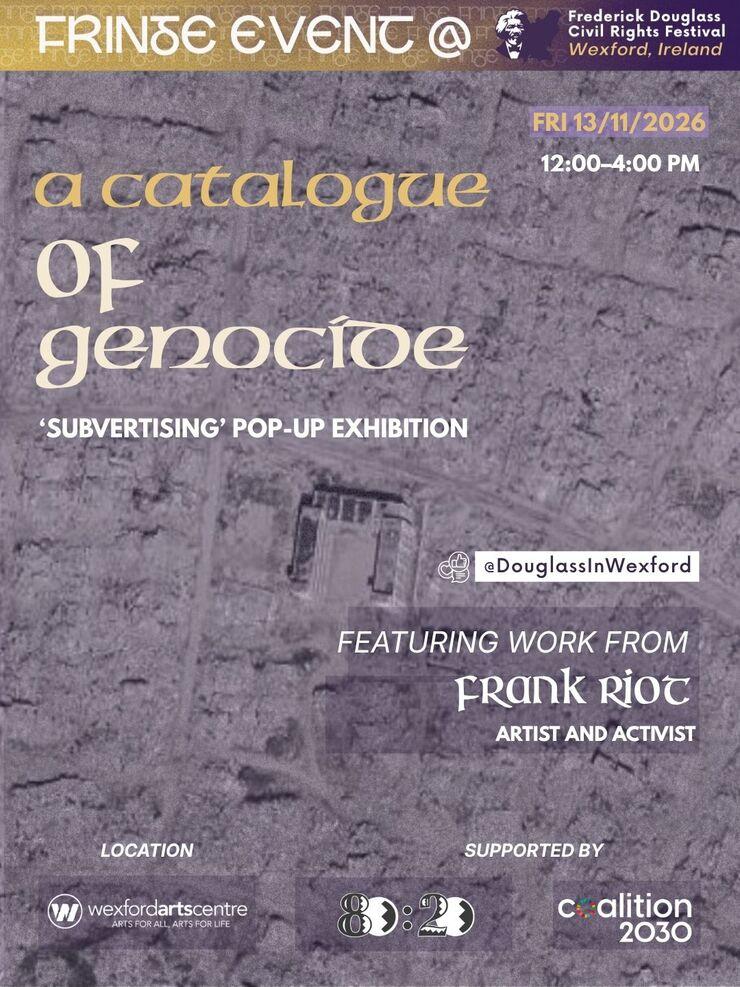
The first event, A Catalogue of Genocide, is a “subvertising” pop-up exhibition featuring work by London-based visual artist, activist and prison abolitionist Frank Riot.
Frank Riot’s work moves across different visual forms and political struggles, addressing subjects including genocide, Palestine, climate breakdown, corporate and technological power, prison abolition and the rights of sex workers. Although the styles may change, from stark text and bold graphic designs to imagery inspired by stained glass, woodcuts and political posters, the intention remains direct: to focus attention on injustices that demand scrutiny and, ultimately, action.
Central to this practice is subvertising: the creative disruption of advertising and other familiar forms of public communication. Corporate messages ordinarily occupy streets, transport systems and digital spaces almost without question. Subvertising borrows their language and visual authority, but turns them against the systems and interests they usually serve.
In doing so, Frank Riot’s work asks us to look again at the messages occupying public space. What are we encouraged to notice? What are we taught to ignore? Who has the power to define what is normal, inevitable or acceptable?
This approach connects closely with 80:20’s commitment to challenging dominant narratives and exposing the systems that produce inequality. It reminds us that injustice is sustained not only through laws, institutions and economic relationships, but also through images, language and repeated stories that make violence appear distant, or even ordinary.
At a time when mass violence can be documented in extraordinary detail and still be denied, minimised or normalised, A Catalogue of Genocide asks what it means to witness injustice without looking away. Its title is deliberately uncomfortable. It refuses the distance that can separate audiences from the realities of violence and challenges the transformation of human suffering into another passing headline, statistic or piece of content.
Friday, 13 November 2026
12.00–4.00pm
Wexford Arts Centre
Featuring work by Frank Riot
Supported by Coalition 2030
The Power of Art for Human Rights
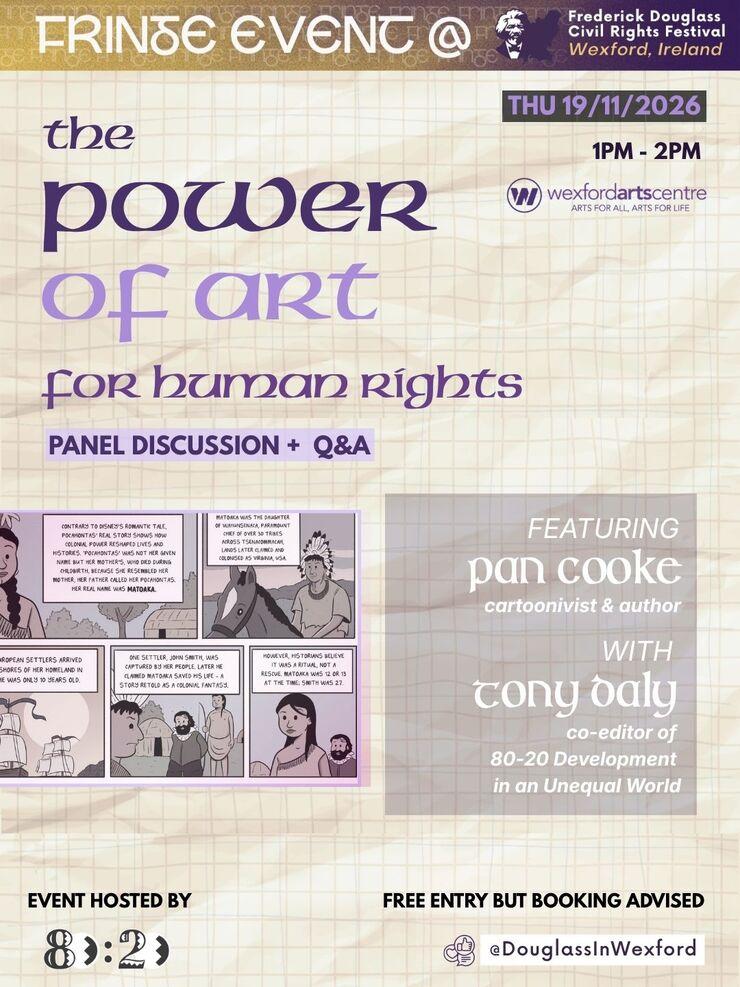
Our second event, The Power of Art for Human Rights, brings together Irish cartoonist, graphic novelist and author Pan Cooke and Tony Daly, coordinator of 80:20 and co-editor of 80-20 Development in an Unequal World, for a panel discussion followed by questions and conversation with the audience.
Pan Cooke’s work demonstrates how visual storytelling can make complex histories of racism, violence and resistance accessible without making them simplistic. His widely shared cartoons have told the stories of Black people killed through police violence in the United States, as well as human rights and environmental activists from around the world.
That movement, from learning to questioning and from questioning to action, is central to 80:20’s approach. We believe that education should help people recognise structural inequality, interrogate dominant accounts of the world and explore what informed action for change can look like. Art can play an important role in that process by making ideas accessible, communicating across different experiences and restoring individuality to people too often presented only as victims or statistics.
The discussion will also confront some of the tensions involved.
- Who gets to tell a story?
- How can artists represent experiences beyond their own without reproducing stereotypes or speaking over those most affected?
- What responsibilities accompany work about oppression and human suffering?
- And in digital spaces shaped by speed and attention, how can visual storytelling deepen understanding rather than simply compete for another moment of visibility?
This is not a conversation about art as decoration. It is about art as a way of seeing, learning, questioning and intervening in the world.
Thursday, 19 November 2026
1.00–2.00pm
Wexford Arts Centre
Featuring Pan Cooke, cartoonist and author
With Tony Daly, 80:20 coordinator and co-editor of 80-20 Development in an Unequal World
Panel discussion and audience Q&A
Supported by Irish Aid
Free entry; advance booking advised
Changing the story is part of changing the world
The world does not become unequal by accident. Inequality is produced and maintained through structures, choices and relationships of power, but also through the stories used to explain and justify them.
That is why education must do more than transfer information. It should help us examine how knowledge is produced, question what has been left out and recognise our own position within unequal systems.
Art can help us undertake that work. It can confront selective memory, expose hypocrisy and connect issues too often treated as separate. At its most powerful, it can move us beyond passive awareness and towards public judgement, solidarity and action.
We invite educators, artists, activists, students and everyone interested in human rights and global justice to join us in Wexford.
Come to look closely. Come to ask difficult questions.
Finally, come to take part in the conversation.