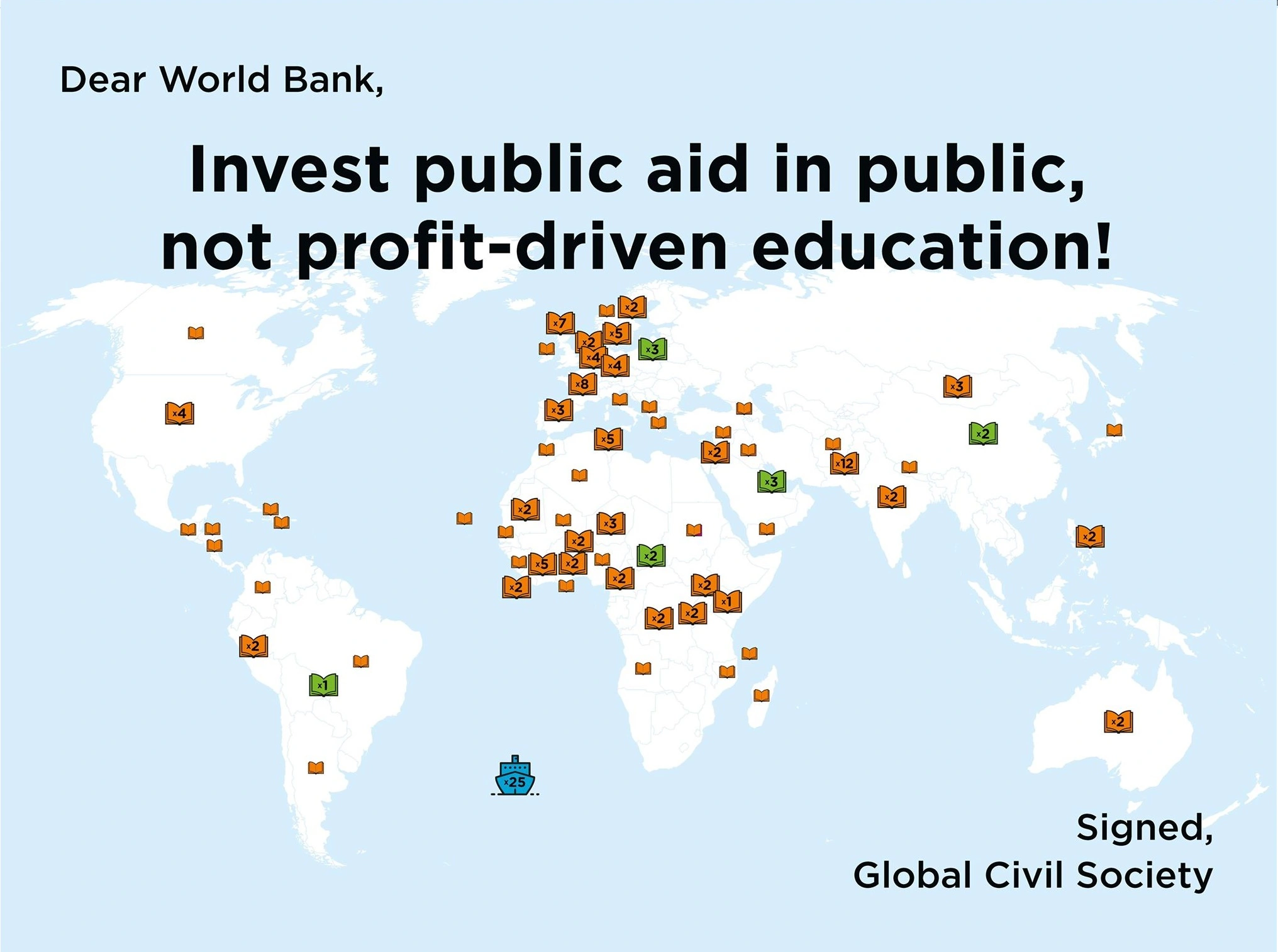
80:20 Educating and Acting for a Better World joined 173 civil society organizations, national education coalitions and unions, based in 63 different countries from every continent in the world in signing a public letter to the World Bank in support of development aid going to free, quality public education.
The letter, released on Wednesday October 15th 2019 on behalf of the signatory organisations, was handed by Zakaria Sulemana from Oxfam in Ghana to David Malpass from the World Bank at a townhall meeting during the World Bank annual meetings in Washington DC.
Read the open letter, notes and list of signatories below.
An open letter to the World Bank and its donors
We, the undersigned, urge you to ensure that development aid for education is used to support the public provision of free, quality education that benefits all without discrimination of any kind, such as discrimination based on socio-economic disadvantage, caste, gender identity, race or disability.
For one thing, education is a human right and an essential part of the global effort to achieve all the Sustainable Development Goals. When education is free, public and good quality, it eradicates indeed poverty, decreases economic and gender inequality, builds active citizens, protects communities and the environment, and forges inclusive and stable societies.
Nonetheless, remarkable progress in education has been made over the last twenty years in large part due to the expansion of free public education. However, many countries have struggled to mobilize sufficient financing for inclusive public education systems of good quality. Unacceptable gaps therefore remain: children in conflict and post-conflict areas, girls, children with disabilities, minorities, refugees, LGBTI+ individuals, and the poorest still lag far behind the most privileged both in access to and completion of education, and in learning achievement.
Private education providers expanding
Instead of responding with greater investments in public education through progressive taxation, some countries have been experimenting with allowing commercial or other private education providers to expand, believing that this is a faster, cheaper route to providing quality education. However it is important to realize that low-fee private schools are not equally accessed by girls or the poorest children. [1]
In fact, they risk excluding learners with special needs including previously out-of-school children. Significantly, studies find that the public funding of private schooling deepens inequalities in education while failing to consistently produce better learning outcomes. [2] In particular, for-profit and commercial schools often rely on poorly qualified and poorly-paid teachers to save costs; furthermore, they have poor transparency and accountability, and side-step important education laws and regulations, undermining a country’s ability to ensure that its educational standards apply equally for all. [3]
Commercialisation of education in lower income countries
At the same time, some donors are actively using public aid money to drive the commercialisation of education in lower income countries, including the World Bank Group. While most of its funding goes to support public education provision, the World Bank is also funding some market-oriented public private partnerships (PPPs) through its International Development Association (IDA), and actively advising countries to pursue PPPs and adopt reforms that reduce regulations and incentivise the growth of private ‘education markets’.[4]
It has also increased its direct support to commercial private education providers through the International Finance Corporation (IFC) – including fee-charging, for-profit school chains,[5] which clearly undermine state obligations as defined in international human rights law.
Meanwhile, the European Parliament and the Global Partnership for Education (GPE), the biggest multilateral fund for education, have both taken strong positions against directing their own aid funding to support commercial or for-profit education provision.
Education is a right, not a market commodity
The UN Human Rights Council, the African Commission on Human and Peoples’ Rights and various UN Treaty Bodies have recognised the obligation to progressively secure free, public – not commercialised – education in fulfilling the right to education.[6]
These positions uphold the principle that education is a right, not a market commodity. Investing in free and inclusive public education of good quality is the best way to ensure fulfilment of SDG 4.
Donors have an important voice in how financial contributions to the World Bank Group are spent, during the ongoing IDA19 replenishment process, as well as in other education financing spaces.
We call on all donors and the World Bank Group itself to take a clear and principled position in support of free, publicly provided education and against the use of development aid to fund for-profit or commercial education.
When you fund education with public aid money, make sure it supports free, quality public education!
The 173 civil society organizations that signed the letter

International organizations
- ActionAid International, International
- Amnesty International, International
- CBM International, International
- DAWN (Development Alternatives with Women for a New Era), International
- Defence for Children International, International
- Disabled Peoples’ International, International
- Education International, International
- FICEMEA, International, International
- GALE: The Global Alliance for LGBT Education, International
- Gender Action, International
- Global Campaign for Education, International
- Global March Against Child Labour, International
- International Disability Alliance, International
- International Trade Union Confederation, International
- Light for the World, International
- Oxfam, International
- Plan International, International
- Right to Education Initiative, International
- Right to Play, International
- The Global Initiative for Economic, Social and Cultural Rights (GI-ESCR), International
- The Lusophone Network for the Right to Education, International
- The Society for International Development (SID), International
- UN Major Group for Children and Youth – FfD/MoI Working Group, International
- VIVAT International, International
- VSO International, International
- Forum for African Women Educationalists (FAWE), Region: Africa
- Africa Network Campaign on Education for All, ANCEFA, Region: Africa
- NGO Forum on ADB, Region: Asia
- Asia South Pacific Association for Basic and Adult Education (ASPBAE), Region: Asia
- East African Centre for Human Rights, Region: East Africa
- European Students’ Union (ESU), Region: Europe
- Bank Information Center Europe, Region: Europe
- Eurodad, Region: Europe
- CLADE (Campaña Latinoamericana por el Derecho a la Educación), Region: LAC
- The Arab Forum for the Rights of Persons with Disabilities, Region: MENA
- Arab Watch Coalition, Region: MENA
- Arab Campaign for Education, Region: MENA
Organizations from A to F
- Afghanistan National Education Coalition (ANEC), Afghanistan
- Albanian Coalition for Education, Albania
- L’association Graine de paix d’Oran, Algeria
- A Rede Angolana da Sociedade Civil de Educação para Todos, Angola
- Communication and Education Program of National University of Cordoba, Argentina
- Armenian Constitutional Right-Protective Centre NGO, Armenia
- RESULTS International Australia, Australia
- The Australian Coalition for Education and Development (ACED), Australia
- Le Miroir Vagabond, Belgium
- Centre national de coopération au développement, CNCD-11.11.11, Belgium
- Défense des Enfants International, Belgium
- RE-SOURCES ENFANCES ASBL, Belgium
- JEVEV ONG, Benin
- Centre d’Actions pour la Sécurité Alimentaire et le Développement Durable, Benin
- The Brazilian Campaign for the Right to Education, Brazil
- La Coalition pour Education Pour Tous BAFASHEBIGE, Burundi
- Syndicats des travailleurs du Burundi STEB, Burundi
- Cameroon Education For All Network (CEFAN), Cameroon
- ONG Fapefe et Noula cib, Cameroon
- RESULTS Canada, Canada
- Rede Nacional da Campanha de Educação para Todos de Cabo Verde (RNCEPT-CV), Cape Verde
- Coalición Colombiana por el Derecho a la Educación – CCDE, Colombia
- Mouvement Associatif pour l’Education et l’Egalité des Chances MAEECHA, Comoros
- TEACH Cote d’Ivoire, Cote d’Ivoire
- Réseau Ivoirien pour la Promotion de l’Education Pour Tous, Cote d’Ivoire
- SOLIDARITE-UNAFETPCI (Union Nationale des Formateurs de l’Enseignement
Technique et Professionnel de Côte d’Ivoire, Cote d’Ivoire - SYNAFETP-CI Syndicat National des Formateurs de l’enseignement Technique
et de la Formation Professionnelle, Cote d’Ivoire - Le Mouvement Ivoirien des Droits Humains (MIDHI), Cote d’Ivoire
- Danish Union of Teachers (DLF), Denmark
- Danske Studerendes Fællesråd, Denmark
- Ghana Venskab, Denmark
- International Aid Services (IAS), Denmark
- The Danish Education Coalition, Denmark
- Foro Socioeducativo de la República Dominicana, Dominican Republic
- Guêpier d’Afrique ONG, DRC
- CONEPT-RDC, DRC
- Coalition Education – France, France
- Humanité et Inclusion, France
- Solidarité Laïque, France
- Aide et Action, France
- SNUipp-FSU, France
- Syndicat général de l’Éducation nationale CFDT, France
- Ligue des Droits de l’Homme, France
From G to M
- Zukunftskonvent, Germany
- World Economy, Ecology & Development (Weed), Germany
- Global Campaign for Education – Germany, Germany
- Gemeingut in BürgerInnenhand (GiB), Germany
- Ghana National Education Campaign Coalition, Ghana
- DebtFreeProject, Advanced Media Institute, Greece
- Colectivo de Educacion para todas y todos de Guatemala, Guatemala
- Regroupement Education pour Toutes et Tous (REPT), Haiti
- El Foro Dakar, Honduras
- 90. LOKMITRA, India
- Right to Education Forum, India
- Wada Na Todo Abhiyan, India
- Centre for Equity and Inclusion (NGO), India
- 94. Odisha RTE Forum, India
- Indian Social Action Forum (INSAF), India
- The Shikshan Mandal, India
- Habitat and Livelihood Welfare Association, India
- Bharat Gyan Vigyan Samuday, India
- Iraqi Institution for Development IID, Iraq
- 80:20 Educating and Acting for a Better World, Ireland
- Global Campaign for Education Italy, Italy
- Japan NGO Network for Education (JNNE), Japan
- Phenix Center for Economic and Informatics Studies, Jordan
- Jordan Coalition for Education, Jordan
- Elimu Yetu Coalition, Kenya
- The Lebanese Union of Persons with Physical Disabilities, Lebanon
- Global Peace and Development Organization, Liberia
- Coalition for Transparency and Accountability in Education – COTAE, Liberia
- Coalition Nationale de Madagascar pour l’education pour tous (CONAMEPT), Madagascar
- Coalition des Organisations de la Société Civile pour l’Education Pour Tous au Mali, Mali
- l’Association pour le Développement Economique, Social, Culturel, Mauritania, Mauritania
- The Coalition of Mauritanian Organizations for Education (COMEDUC), Mauritania
- GSEA Mauritius, Mauritius
- Government Teachers Union, Mauritius
- All for Education, National CSOs coalition, Mongolia
- Oyu Tolgoi Watch, Mongolia
- Rivers without Boundaries Coalition, Mongolia
- Moltaka al Osra al Maghribia, Morocco
- Movimento de Educação Para Todos -Moçambique, Mozambique
From N to S
- National Campaign for Education Nepal (NCE Nepal), Nepal
- Foro de Educación y Desarrollo Humano de la Iniciativa por Nicaragua (FEDH IPN), Nicaragua
- La Coalition Nigérienne des Associations, Niger, Syndicats et ONG de Campagne EPT, Niger
- Syndicat national des agents de la formation et de l’éducation du Niger (SYNAFEN), Niger
- Syndicat National des Enseignants du Niger, Niger
- Civil Society Action Coalition on Education for All (CSACEFA), Nigeria
- SAIH – Norwegian Students’ and Academics’ International Assistance Fund, Norway
- Social Youth Council of Patriots SYCOP, Pakistan
- Training and Services (ARTS) Foundation, Pakistan
- Society for Community Strengthening and Promotion of Education, Pakistan
- Pakistan Coalition for Education, Pakistan
- Al-Eimman Development Organization, Pakistan
- Rural Development Organization, Pakistan
- Youth Organization, Pakistan
- Youth Front Pakistan, Pakistan
- Al Kousar Welfare Organization, Pakistan
- HWA Foundation, Pakistan
- Pakistan Youth Change Advocates, Pakistan
- Blue Veins, Pakistan
- Campaña Peruana por el Derecho a la Educación, CPDE, Peru
- Foro Educativo Peru, Peru
- WomanHealth Philippines, Philippines
- The Civil Society Network for Education Reforms (E-Net Philippines), Philippines
Organizations from S to Z
- le Syndicat National de l’Enseignement Elémentaire (SNEEL-CNTS), Senegal
- Community Action to Restore Lives, CARL, Sierra Leone
- Observatorio de la Deuda en la Globalización ODG, Spain
- Educo, Spain
- Campaña Mundial Por la Educacíon, Spain
- Sudanese Coalition for Education For All (SCEFA), Sudan
- Diakonia, Sweden
- Lärarförbundet, Sweden
- Transnational Institute, the Netherlands
- Wemos, the Netherlands
- Amis des Étrangers au Togo (ADET), Togo
- La Coalition Nationale Togolaise pour l’Éducation Pour Tous (CNT/EPT), Togo
- Association Tunisienne de Droit du Développement, Tunisia
- La Ligue Tunisienne pour la Défense des Droits de L’Homme, Tunisia
- Association des Amis du Belvédère, Tunisia
- Maan, Tunisia
- Ligue Tunisienne de l’Education, Tunisia
- Witness Radio Organisation, Uganda
- The Initiative for Social and Economic Rights (ISER), Uganda
- Jubilee Scotland, UK
- NASUWT The Teachers’ Union, UK
- National Education Union, UK
- Global Justice Now, UK
- The Bretton Woods Project, UK
- The Equality Trust, UK
- Send my Friend to School, UK
- Bank Information Center (BIC), USA
- Global Campaign for Education-US, USA
- The Oakland Institute, USA
- RESULTS, USA
- Wedyan Association For Society Development, Yemen
Notes
[1] Day Ashley L., et al. (2014) The role and impact of private schools in developing countries: a rigorous review of the evidence, DFID bit.ly/2kuWody; Srivastava, P. (2013) “Low-fee private schooling: issues and evidence” in P. Srivastava (Ed.) Low-fee Private Schooling: aggravating equity or mitigating disadvantage? Oxford Studies in Comparative Education Series (Symposium Books, Oxford, 2013).
[2] K.M. Bous and J. Farr (2019) False Promises: How delivering education through public-private partnerships risks fueling inequality instead of achieving quality education for all. Oxfam Briefing Paper. bit.ly/2m2GZlj
[3] For example see: Republic of Uganda in the High Court of Uganda at Kampala, Bridge International Academies vs. Attorney General: Ruling. March 16, 2018. bit.ly/2m3NV1B. Riep, C. (2015) Omega Schools Franchise in Ghana: A case of “low-fee” private education for the poor or for-profiteering? ESP Working Paper Series. Kenya National Union of Teachers and Education International (2016) Bridge vs. Reality: A study of Bridge International Academies’ for-profit schooling in Kenya bit.ly/2g06UWO; Education International, Regulatory framework for Philippine private schools and practices in APEC schools bit.ly/2lzGWNG
[4] K.M. Bous and J. Farr (2019) op.cit.
[5] Baker, T. and W. Smith (2017) From Free to Fee: Are for-profit, fee charging private schools the solution for the world’s poor? RESULTS Educational Fund. bit.ly/2kuWm5q
[6] For statements by international human rights bodies, see bit.ly/2kld8nP. See also the Report of the UN Special Rapporteur on the Right to Education, (2019) Right to education: the implementation of the right to education and Sustainable Development Goal 4 in the context of the growth of private actors in education bit.ly/2kwj90S; and the 2018 Report of the UN Special Rapporteur on Extreme Poverty and Human Rights on privatization and its impact on human rights, undocs.org/A/73/396.